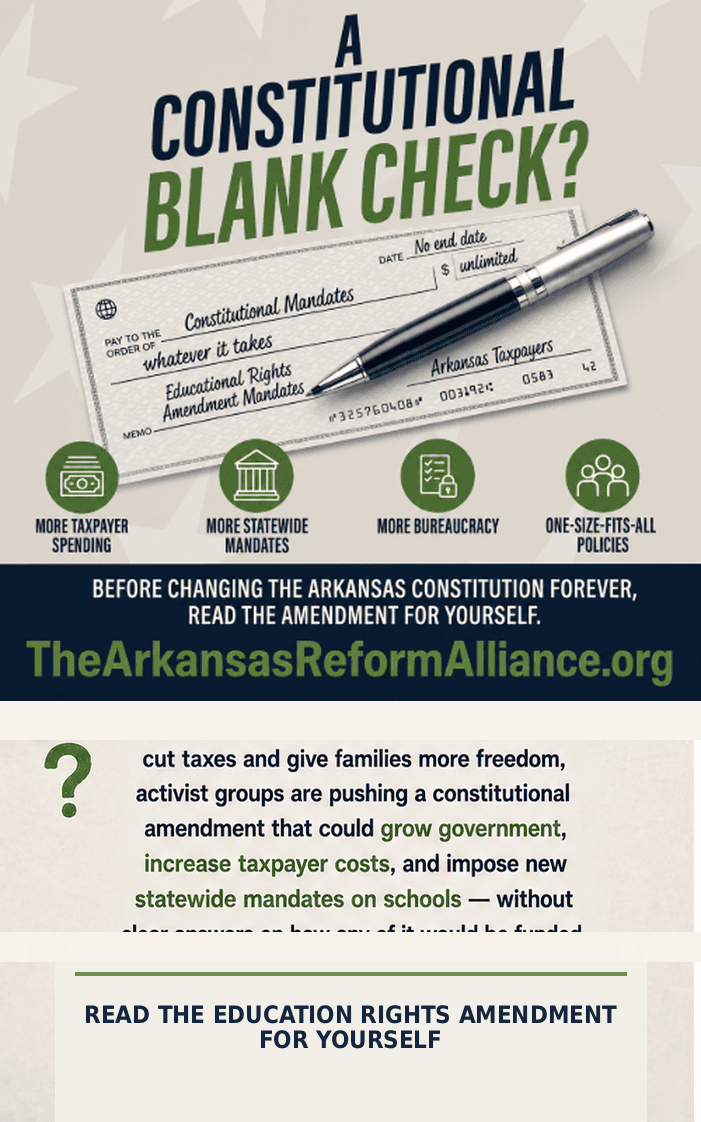
A Constitutional Blank Check?
At a time Arkansas is working to cut taxes and give families more freedom, activist groups are pushing a constitutional amendment that could grow government, increase taxpayer costs, and impose new statewide mandates on schools — without clear answers on how any of it would be funded.
Read “The Education Rights Amendment” for yourself.
Our Children. Our Schools. Our Future.
The Arkansas Constitution — and our education system — are at risk.
Supporters call it the “Education Rights Amendment.” But buried inside is a constitutional blank check requiring taxpayers to fund massive new government mandates with no clear plan to pay for them.
The amendment could threaten the freedom families have to choose the best schools for their children and reduce local control for Arkansas communities.
- More statewide mandates.
- More bureaucracy.
- More taxpayer spending.
- One-size-fits-all policies.
Read the amendment for yourself. Transparency before constitutional change.
 Read “The Education Rights Amendment” section below
 Read “The Education Rights Amendment” section below Read the amendment for yourself below
“The Education Rights Amendment”
Official ballot title language
Popular Name: The Arkansas Educational Rights Amendment of 2026
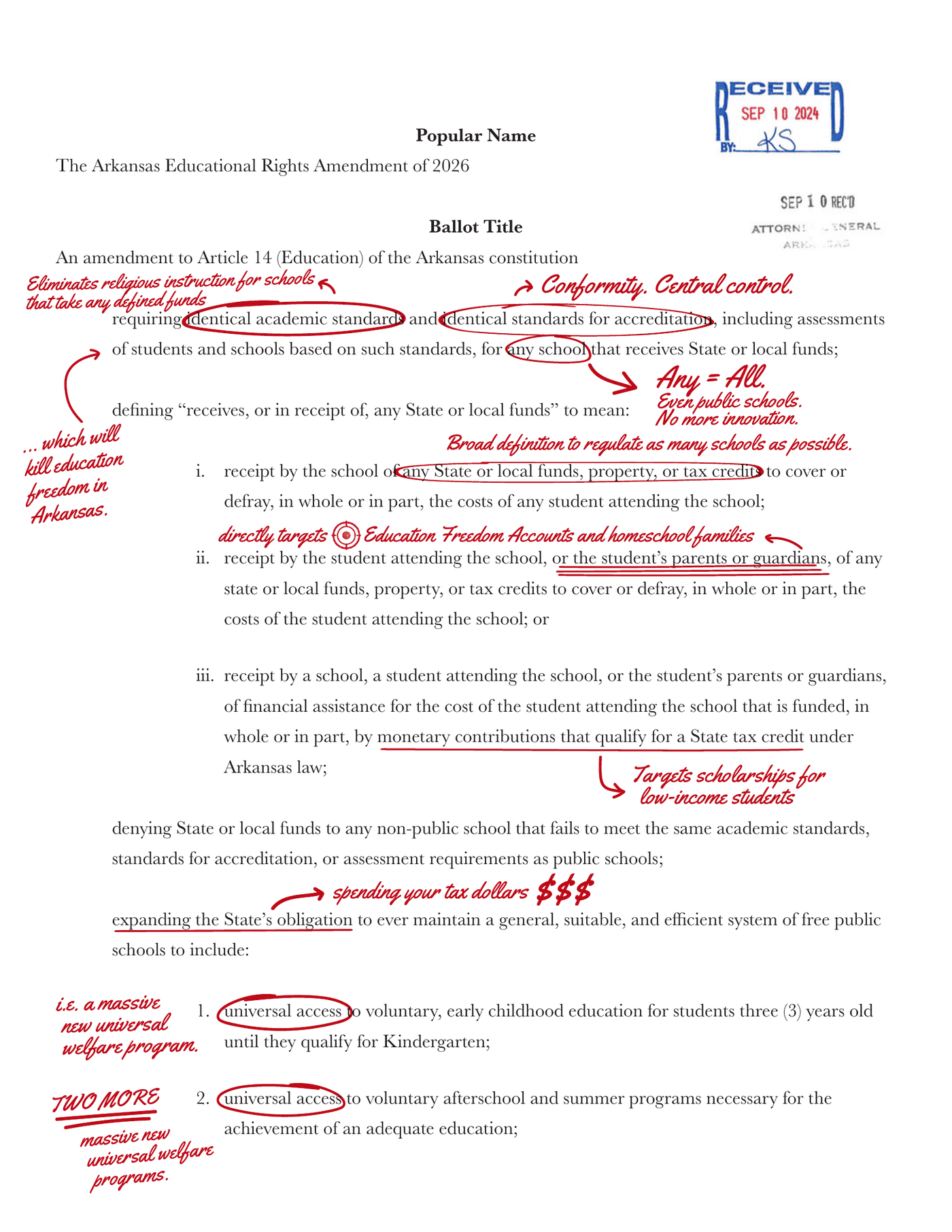
An amendment to Article 14 (Education) of the Arkansas constitution requiring identical academic standards and identical standards for accreditation, including assessments of students and schools based on such standards, for any school that receives State or local funds; defining “receives, or in receipt of, any State or local funds” to mean: (i) receipt by the school of any State or local funds, property, or tax credits to cover or defray, in whole or in part, the costs of any student attending the school; (ii) receipt by the student attending the school, or the student’s parents or guardians, of any state or local funds, property, or tax credits to cover or defray, in whole or in part, the costs of the student attending the school; or (iii) receipt by a school, a student attending the school, or the student’s parents or guardians, of financial assistance for the cost of the student attending the school that is funded, in whole or in part, by monetary contributions that qualify for a State tax credit under Arkansas law; denying State or local funds to any non-public school that fails to meet the same academic standards, standards for accreditation, or assessment requirements as public schools; expanding the State’s obligation to ever maintain a general, suitable, and efficient system of free public schools to include: (1) universal access to voluntary, early childhood education for students three (3) years old until they qualify for Kindergarten; (2) universal access to voluntary afterschool and summer programs necessary for the achievement of an adequate education; (3) assistance to children who are within 200% of the federal poverty line so that the qualifying children can achieve an adequate education and overcome the negative impact of poverty on education; and (4) services that fully meet the individualized needs of students with disabilities to allow them meaningful access to integrated education; defining an adequate education as, without limitation, all children developing sufficient: (1) oral and written communication skills to enable students to function in a complex and rapidly changing civilization; (2) knowledge of economic, social, and political systems to enable students to make informed choices; (3) understanding of governmental processes to enable students to understand the issues that affect their community, state, and nation; (4) self-knowledge and knowledge of their mental and physical wellness; (5) grounding in the arts to enable students to appreciate their cultural and historical heritage; (6) training, or preparation for advanced training, in either academic or vocational fields, so as to enable children to choose and pursue life work intelligently; and (7) academic or vocational skills to enable public school students to compete favorably with their counterparts in surrounding states, in academics or in the job market; requiring the General Assembly to enact legislation to implement this amendment, including allocating funding necessary to fully implement this amendment; forbidding the General Assembly from amending, altering, or repealing this amendment absent a vote of the people; and providing that this amendment’s provisions are severable.
Marked-up ballot title
Read the Fine Print
This marked-up version shows the ballot title language with issue notes and emphasis added.

Markup notes visible in the ballot-title images
The marked-up pages include notes describing broad regulation of schools, central control, impact on Education Freedom Accounts and homeschool families, spending concerns, universal welfare program concerns, cost questions, funding questions, permanence, and restrictions on future General Assembly changes.